 European Sign Federation
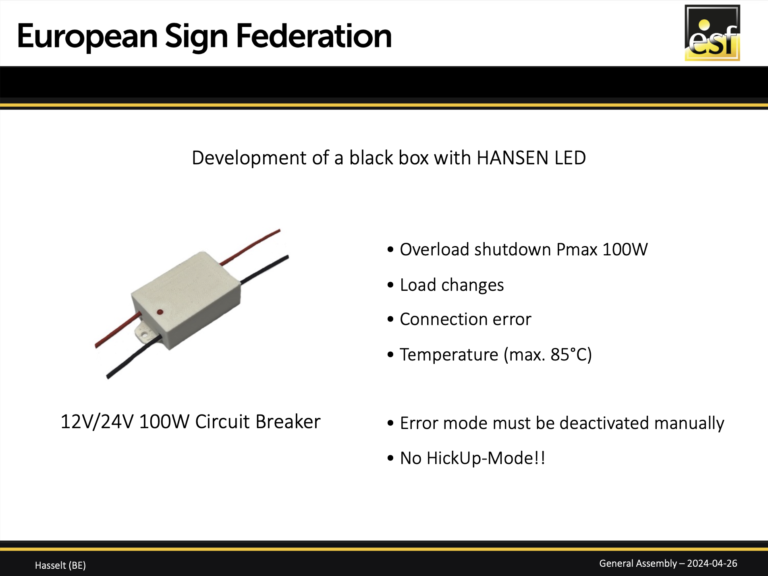
Some things need a little more time to accompany product development and to achieve progress for the illuminated advertising industry. The LWD was all the more proud to be the first to present a newly developed circuit breaker for illuminated advertising systems with LED lighting exclusively to its members at the last annual meeting and to explain how it works and the added value in terms of safety for illuminated advertising.
Why EN 50107-3 is important
When it comes to the operational safety of illuminated advertising systems with LED lighting, this topic is often underestimated or neglected because the voltages involved are 12 or 24 volts. But even with these low voltages, if a neon sign is not properly grounded, there is not only a risk of short circuits or electric shock, but also a significant risk of fire due to overheating of the components caused by the use of oversized transformers, connectors or incorrect cable cross-sections.
With so many safety-related aspects to consider, it was strange that the previous standard EN 50107-3:2018 “Product standard for illuminated signs using discharge lamps and/or LEDs (light-emitting diodes)” was withdrawn. The withdrawal of the product standard EN 50107-3 in 2021 represented a step backwards for the illuminated sign industry. However, the standard was not withdrawn due to technical deficiencies, but solely due to legal and national reasons and conflicts with the lighting industry’s technical committee. It is extremely important to keep reminding people that the published technical content of the standard continues to apply to the manufacture of illuminated signage.
It has been more than four years since the LWD – in personas Hans Joachim Kremser and I – spoke with an LED and electronics supplier at WETEC 2020(!) in Stuttgart about the possibilities of an additional protective device. This was required in chapter 4.4.3 “Additional protective devices for earth fault and open circuit protection devices”, but there was only a very rudimentary description of how the solution could be designed.
My question to the technical committee responsible for developing the standard had been answered by then, but it was not very useful and not very installation-friendly: After initial commissioning and measurement of the current, a fuse is installed on the secondary side between the transformer and the LED installation.
Black Box for More Fire Protection
In order to make the required protective device as easy to install as possible for the fitters, something else had to be done. I was sure of that; for the sake of simplicity, I called it a black box and created a requirements profile that met the criteria of EN 50107-3. Then the pandemic came and with it the withdrawal of EN 50107-3 by the EU and the paper disappeared from focus.
At the LWD ERFA conference in September 2021 at Hansen LED in Haselund, I asked Tim Hansen about the project and whether Hansen had the means and capacity to develop and build such a protective device. Even though another two years passed, at the end of 2023 we received feedback that Christian Gonnsen, development engineer at Hansen LED, had largely completed the development of a 100W circuit breaker for 12/24V LED systems, the BlackBox – now with a white housing for less shadows when installed in an illuminated advertising system.
Now it was time to fine-tune and pick up speed, because it was Tim Hansen’s and my wish to present the circuit breaker at the LWD Annual Conference in Dresden in 2024, which we managed to do. How important this component is was then shown at the presentation of the circuit breaker at the last ESF General Assembly in Hasselt (B) at the end of April. Here, the Italian delegates reported that just in mid-April in Italy (photo) a 12V LED advertising system powered by a 150W transformer burned down.
The circuit breaker is now in the testing phase and is expected to be available in the second half of 2024.
How does the circuit breaker work?
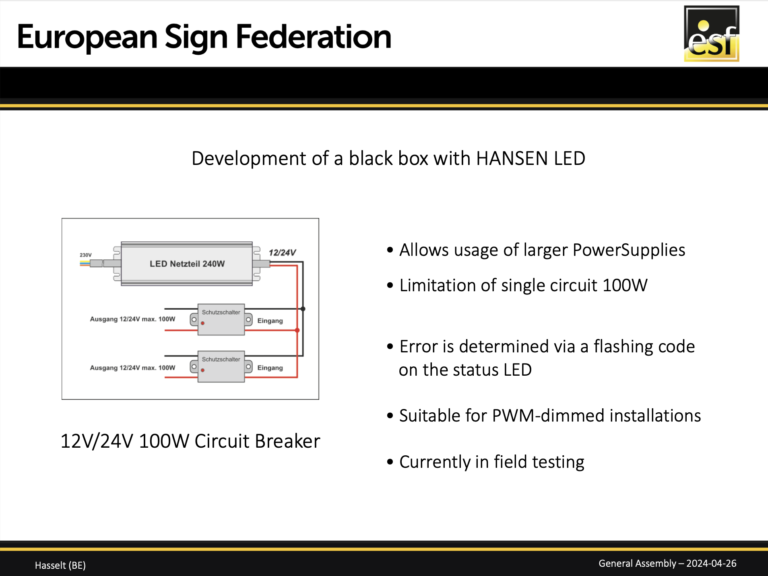
The 12V/24V 100W circuit breaker monitors the power consumed by an LED circuit and switches off if the power consumption is too high/short circuited (>100W). This significantly reduces the risk of fire in illuminated advertising systems when using high-performance power supplies. If the power consumption changes during operation over time (decrease or increase in total power by 20%) or if there are connection errors (contact errors), the device switches to an error mode within 0.3 seconds.
The type of error is determined by a flashing code of the status LED. The error mode can only be ended by a special reset process.
The fire protection switch is also suitable for dimmed systems (via PWM).
Don’t transformers have such a shutdown built in?
Even though many transformers, but not all of them, have a so-called Hiccup Mode 1 , this does not meet the requirements of EN 50107-3 to shut down the power supply in the event of a short circuit.
The actual cause of the error in the LED installation is not corrected, which would be necessary. Rather, this mode automatically switches the transformer back on without
an inspection and repair. Ultimately, this can lead to an overload and fire in the installation – as in the case described above.
Two birds with one stone…
In addition to the safety-enhancing factor and the ease of installation, there is another advantage of the circuit breaker. The use of the circuit breaker will allow larger transformers to be used again in the future. Until now, the standard only allowed a maximum of 100W transformers to be used to represent the limit of 100W per individual circuit of an illuminated advertising system. With the use of several circuit breakers, larger transformers can also be used again, provided that the individual outputs on the secondary side are each protected with a separate circuit breaker.
Author: Thomas Berens – LWD Board Member, ESF Board Member Technical Director
1 Hiccup mode describes a special form of overload protection.
In the event of an output overload or short circuit, the power supply switches off briefly and then restarts cyclically (approximately every second) to check whether the overload has been resolved. (Hiccup = hiccup)